
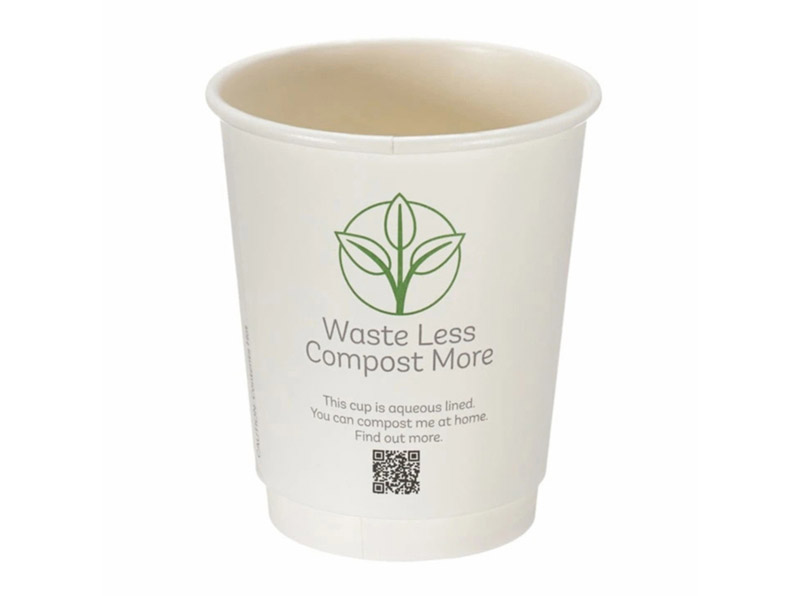
Your questions answered: ‘What to do with “compostable” coffee cups?’
A supporter asks: After some research, our church switched to using compostable cups for morning coffee and other church events. We thought this would be better for the environment. However I’ve learned the cups can’t go in the composting bins at the amenity tip at Maresfield – nor in home composting caddy bins. What can we do?
I don’t understand why they can’t go into the garden waste facility at the amenity tip, if they’re compostable. I have emailed the manufacturer Go-Pak to ask how long the cups would take to break down on a small garden ‘cold’ compost heap but haven’t heard back yet. Their own website says to home compost or to contact your nearest industrial composting site.
Neil Peters, Community Recycling Engagement Officer at Environment First for Lewes District Council, responds:
You shouldn’t put compostable coffee cups (or any compostable packaging) into your garden or food waste bin in East Sussex. According to guidelines from East Sussex County Council and Lewes District Council, all compostable coffee cups, packaging, and bioplastics must go into your general rubbish bin.
The reasons behind this policy come down to how the local processing facility works and the mechanics of bioplastics. The majority of East Sussex’s organic waste is processed at Veolia’s Woodlands In-Vessel Composting (IVC) Facility in Whitesmith. Woodlands uses an intensive, 14-day high-temperature composting phase followed by a short maturation period.
Plant-based bioplastic coatings (like PLA – polylactic acid) usually require up to 12 weeks (84 days) under strict industrial conditions to break down completely without leaving fragment residues. In a 14-day cycle, the cup simply won’t degrade in time.
The Lewes District Council organic waste is sent to KPS Composting Services Ltd, where it undergoes a more natural composting process. Even with garden waste heading to KPS Composting in Isfield, the short answer remains the same: you still cannot put compostable coffee cups into your garden waste bin. In fact, the process at Isfield makes it even less suitable for bioplastic cups than an enclosed industrial facility like Woodlands.
Here is why open-air sites like KPS strictly exclude coffee cups and packaging:
- Open-air open windrow composting
KPS operates an ‘open windrow’ system. Green waste is shredded, piled into long outdoor rows (windrows), and turned mechanically over several weeks to introduce oxygen. Unlike the enclosed IVC facilities mentioned above, open windrows are subject to ambient weather, moisture fluctuations, and temperature drops near the surface of the pile. Plant-based polymer linings like PLA require constant temperatures of 58°C to 70°C alongside high humidity for weeks on end to break down. Open windrows simply cannot guarantee these uniform conditions throughout the entire heap.
- Environmental and wildlife risks
Because Isfield is an outdoor site, lightweight items like paper coffee cups pose immediate operational risks:
- Wind: When shredded material is turned outdoors, thin cups and cardboard fragments easily blow off-site as visual litter.
- Scavenging: Food or drink residue in coffee cups attracts birds and pests to open piles, which breaks Animal By-Product Regulations (ABPR).
- Mechanical screening and microplastics
At the end of the composting cycle, the material is passed through heavy rotary screens (trommels) to separate fine soil conditioner from larger woody bits. Semi-degraded compostable cups will either:
- Get screened out as “trash”: Ending up in the rejected waste pile anyway (wasting the processing energy).
- Break into tiny pieces: Shredding into micro-fragments that contaminate the final organic compost, preventing KPS from meeting PAS 100 certification standards for agricultural use.
The bottom line: Whether it’s food waste destined for an In-Vessel system (Woodlands) or garden waste bound for Open Windrows (Isfield), the rule across East Sussex is uniform: green waste bins are strictly for organic garden vegetation (grass, cuttings, leaves, wood), and food caddies are strictly for food scraps (plus certified EN 13432 caddy liners).
All coffee cups, regardless of “compostable” claims, belong in the general waste bin. Better to use reusable cups that can be washed and used again.
Got a question for Lewes Climate Hub? Email us at