
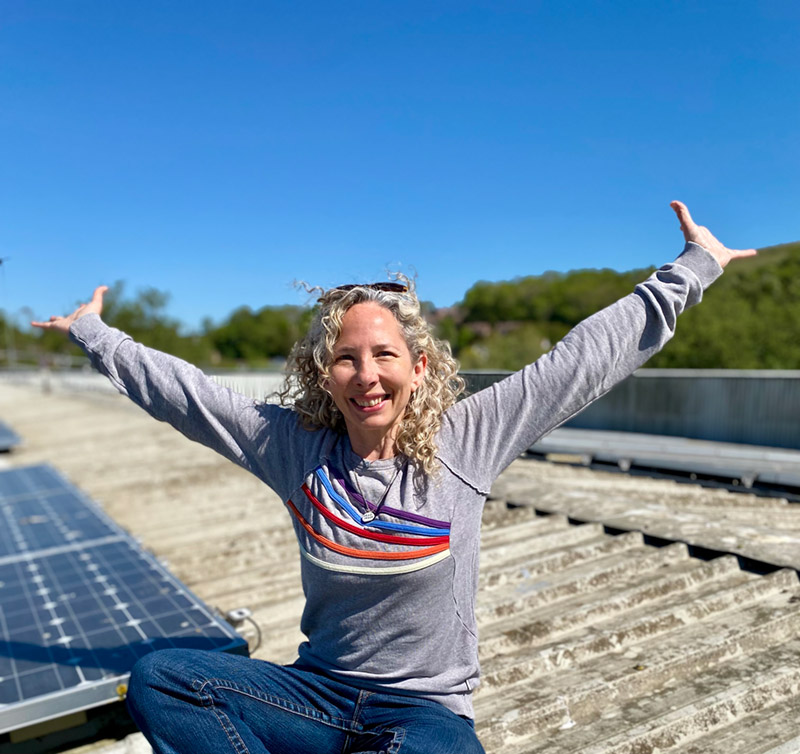
The Mica-Scope: Who Owns the Sunshine?
With the latest OVESCO community energy share offer in full swing, Lewes-based sustainability consultant Mica Janiv wonders if it’s a model of ownership we should be using for a lot more of the things we need in our lives.
What do solar panels and seaweed have in common?
No, this isn’t the beginning of a terrible joke. Genuine question. And the answer is: a solar farm near Chichester.
‘How so?’ you ask.
Well, Meadow Blue Community Energy’s solar farm at Merston is a Community Benefit Society. It is owned by the people who invested in it to get it built. They generate electricity, sell some of it to the grid, and any surplus is channelled into a community benefit fund. The members have a say in how that money is used.
‘Why seaweed?’ you ask.
Because one of the things they voted to fund was the Sussex Kelp Recovery Project. To date, Meadow Blue has given £30,000 to the project, alongside funding other local initiatives.
So there we have it:
Solar → electricity → income → kelp.
That is quite a journey for a ray of sunshine.
From kelp to beer
Here in Lewes, we have our own community energy organisation, OVESCO. In fact, OVESCO helped develop Meadow Blue and raised £1.2 million through a community share offer in 2015 to create the 5MW solar farm.
And before that, back in 2011, Lewes locals invested in one of OVESCO’s first (and one of the UK’s first) community share offers to put solar panels on the roof of Harvey’s Brewery Depot. The panels are still up there, generating electricity.
I’m very taken with this model. The principle is wonderfully simple. Put some local money into something useful. Build something that generates value. Keep some of that value local. And give the people who own it a say in what happens next.
We see versions of this instinct elsewhere in Lewes too. Lewes FC has been community-owned since 2010, with one share and one vote. It isn’t the same model as community energy, but the basic idea will be familiar to anyone who has ever bought into the club: if people care about something, why not give them a stake in it?
Another whip-round?
OVESCO’s fourth share offer is live right now.
Since 2011, its members have invested £490,000, helping create 230kWp* of community-owned solar across Sussex. Those installations have generated more than 4.2 million kWh** of power and avoided an estimated 1,446 tonnes of CO₂.
The current offer is funding the creation of solar arrays at three much-loved local enterprises: Holmansbridge Farm, Raystede Centre for Animal Welfare, and the Bevern Trust, which supports people with profound disabilities. Together, the three arrays are expected to generate around 205,000 kWh a year. The organisations will buy the electricity generated on their roofs at a capped price, giving them cheaper, more predictable energy while the community owns the infrastructure.
And if you invest, you become a member of OVESCO. Whether you put in £250 or £35,000, you get one vote.
Turns out, we’re not that special (wait, what?)
None of this is new. And it isn’t just a Sussex or British curiosity.
The Rapid Transition Alliance has documented community-owned energy projects around the world, from Denmark to Germany.
Denmark has gone so far as to require new wind projects to offer at least 20% community ownership. In Germany, one study estimated that citizens owned 40% of renewable generation capacity in 2019.
So why isn’t this simply how we build things?
Turns out the idea is actually rather old. The model stretches back to the Rochdale co-operative movement of 1844: people pooling their money, owning something together and having a say in what happens to the value they create.
Perhaps, thanks to the move to privatisation in the 1980s, we’ve just got remarkably good at not owning things.
The things we don’t own
Most of what makes our lives work belongs to someone else, and we’ve stopped noticing. Electricity arrives at the socket, which is about as far as I want to think about it while I’m making toast.
Ownership isn’t a neutral detail, though. Whoever owns something gets to decide what happens to it, and gets the financial benefit when it goes well.
Brett Christophers, author of The Price Is Wrong, argues that the renewable energy transition cannot simply be left to private investment and the hope that markets will sort it all out. It needs enormous investment, infrastructure and government intervention.
And Britain is about to build a lot of that infrastructure.
So the question isn’t only how much renewable energy we build. It’s also who owns it. It can look like the familiar system of big assets, distant owners, customers at the end of the pipe.
Or we could own a bit of it ourselves.
Pass the hat
Nobody’s suggesting Lewes clubs together to buy the National Grid before tea. But Harvey’s Brewery roof is proof that infrastructure can belong to the people living underneath it, without anyone needing to become an energy expert or develop a personal interest in kilowatt hours.
Fifteen years on, those panels are still up there. And now there’s another farm, an animal sanctuary and a disability charity joining the experiment.
Somewhere between the roof of a brewery depot and the bottom of the Sussex Channel, there’s a rather lovely reminder that infrastructure doesn’t have to belong to somebody else.
Because when the big world says: this needs enormous capital, markets, governments and infrastructure. Lewes says: fine. We’ll have a whip-round.
Sources & further reading
- OVESCO: 2026 Share Offer
- One Member, One Vote: The History Behind How We Fund Community Energy
- Rapid Transition Alliance: Reclaiming Power — community renewable energy around the world.
- Brett Christophers, The Price Is Wrong: Why Capitalism Won’t Save the Planet — on the limits of relying on markets and private investment to deliver the energy transition.
- Guardian review of above book
* kWp = kilowatt peak – the maximum power output that a solar panel or photovoltaic system can produce under ideal, standardized test conditions
** kWh = kilowatt hour – a unit of measurement that tracks the total amount of electrical energy used over time; 1kWh is equal to using 1,000 watts of power continuously for one full hour