
The Mica-Scope: Smoke & Mirrors
By Mica Janiv
Every November someone corners me with the same question: Isn’t Bonfire terrible for the planet? Yes. For one night, loudly, with burning barrels. But three weeks later something far bigger turns up, with better PR and no smell at all.
This month: the smoke we can see, the mirrors we can’t, and why Lewes shouldn’t put its torch down just yet.
The question
Every year, somewhere between the first rookie and the fifth, someone leans in and asks, in the voice usually reserved for confessing to a second sausage roll: “Isn’t Bonfire terrible for the environment?”
Short answer: Yes. Long answer: Yes, but keep reading.
The smoke
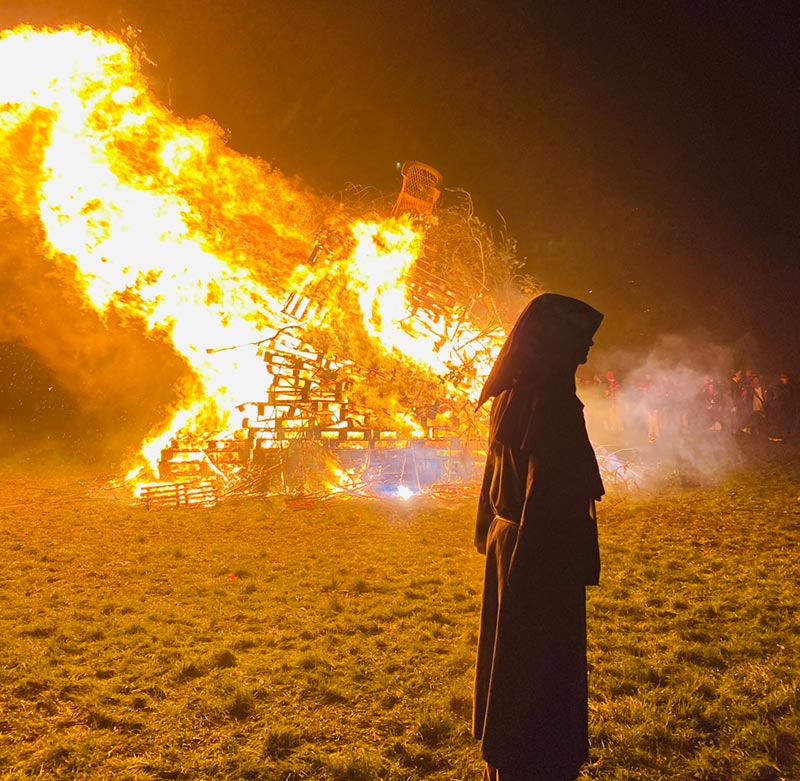
Lewes Bonfire is not a sparkler in a back garden. It’s several processions, thousands of marchers in smugglers’ stripes, burning torches, flaming tar barrels (some lobbed into the Ouse) and five mahoosive bonfires ringed around a town swollen to more than 300% of its usual size with visitors. We don’t do subtle. We do arson with a brass band.
And the impact isn’t hard to see. The council’s air monitor on Little East Street broke the daily limit for fine particles exactly once in 2024. Have a guess which night. Researchers at the University of Leeds measured soot at around 100 times normal on Bonfire Night, and the metals that make fireworks pretty also make the particles worse to breathe.
The wildlife doesn’t get a vote either. Nobody has studied Lewes birds on the 5th of November, which is odd for a town where South Street Bonfire Society lights its fire on the Railway Land nature reserve. But a Dutch study that GPS-tracked 347 wild geese found fireworks sent them up to 16km further than usual, and they spent the next 12 days eating to recover. Twelve days. To be fair, I need about the same.
But here’s the thing about the smoke. You can see it. You can smell it in your hair on the 6th of November. By 7.30am the council has cleared six and a half tonnes of rubbish, and not one society has ever claimed the 5th is carbon neutral.
Bonfire is a pollution event that knows it’s a pollution event. Frankly, I find that refreshing.
The mirrors
Three weeks later, on 27 November, Black Friday rolls in. No drums, no flames, nobody in a stripey jumper. Just your phone, buzzing like a wasp trapped in a jam jar.
Its smoke is invisible. One back-of-envelope estimate, Money.co.uk’s Dirty Delivery Report, put a single Black Friday’s UK deliveries at around 429,000 tonnes of CO₂. A mature tree soaks up about 22kg of CO₂ a year, which means mopping up one Black Friday would take nearly 20 million of them a full year. The maths is rough because Black Friday carbon emissions are spread so thinly across the nation’s doorsteps, no monitor on Little East Street could ever catch them.
And the bargains? Which? tracked 201 Black Friday deals and found 99.5% were the same price or cheaper at some other point in the year. Starling Bank found 29% of shoppers regretted their haul, and 23% had bought something they never used. Somewhere in your loft there is a spiraliser that agrees.
Then comes the gloss: the “conscious” edit, the “planet-friendly” packaging, the tree planted with every order. That’s the mirror. It’s been angled very carefully towards a well-placed leaf icon, and the lighting is very kind.
The mirrors are cracking
Good news, though. Since 27 September, a new EU law has banned words like “eco-friendly” without proper certification, and outlawed “carbon neutral” claims built on offsets. Apple took “carbon neutral” off its watches. H&M dropped its “Conscious” label. Funny how fast a word vanishes once someone asks for evidence.
Britain isn’t covered, but in September the Advertising Standards Authority banned ads from Thomas Cook, loveholidays and DialAFlight for calling hotels “eco” without saying why. Even when “eco” was in the hotel’s name. You can’t christen your way out of it.
And that tree with every order? Under the UK’s Woodland Carbon Code, new woodland can’t offset anything until the carbon has been verified, which can take decades. Of 850,000 saplings planted beside the A14, around three-quarters died. Your Black Friday tree may not be feeling its best either.
What’s still standing
The good trees are closer than you think, and none of them comes with a discount code.
Trees for the Downs has planted more than 100,000 across Sussex and Hampshire since 2019, and has never once claimed they cancel out your shopping. It plants trees, replaces the elms and ash we’ve lost to disease, and helps farms and schools look after them.
Lewes Urban Arboretum planted 57 trees round the edge of Convent Field, where Southover Bonfire Society lights its bonfire, and budgeted for two years of watering. That’s what a tree costs.
In September, Lewes Town Council adopted a ground-breaking Rights of Trees Charter, developed through the work of the local Rights of Our Trees (ROOTS) group and supported by a range of environmental, legal and community organisations, making it one of the first councils in the country to recognise trees as living beings with interests worth weighing.
And if a tree you love is under threat, Sussex Law School has published a free Rights of Trees toolkit on using the law to protect it. It has already been used to support the 1066 Yew at Crowhurst, which has seen off considerably worse than Black Friday.
End note: We wunt be druv
Sussex’s unofficial motto. Roughly: we won’t be pushed around.
Lewes is magnificent at this for one night a year. We’re honest about our vices, loud about our grievances and deeply suspicious of anyone telling us what to do. I’m asking for three more weeks of it.
On 27th November, when the countdown clocks start and the inbox shrieks LAST CHANCE, be as stubborn as a Bonfire Boy who’s been told to go home. Don’t buy anything you didn’t want on the 26th. If you’re spending, spend it locally. And if a sale tells you it’s saving the planet, ask it to prove it.
We wunt be druv. Not on the 5th of November, and not on the 27th either.
Resources
Get involved in Lewes
- Lewes Urban Arboretum — Friends of Lewes: the town’s trees, mapped and named, with tree walks, talks and planting days. Get in touch through the site.
- Donate to Trees for the Downs — South Downs National Park Trust: give directly to native tree planting across Sussex and Hampshire, no offset claims attached.
- Railway Land Wildlife Trust: the charity behind the nature reserve where South Street lights its fire. Volunteering roles include events and wellbeing.
Know your rights
- Rights of Trees, Woodlands and Forests toolkit — University of Sussex (free PDF): how to use the law to protect a tree or woodland you care about.
- Environmental Justice Law Clinic — University of Sussex: free support for individuals and community groups with environmental concerns.
- Make a complaint — Advertising Standards Authority: spotted a green claim that doesn’t add up? Anyone can report an ad, and it’s free.
- Sussex-air: air quality levels and reports for Lewes and the rest of Sussex.
For Lewes businesses
- Make an environmental claim for your product, service or organisation — GOV.UK: the Competition and Markets Authority’s plain-English guide to green claims that stay on the right side of the law.
- ECGT Directive explained — Carbon Trust: what the new EU rules mean if you sell to customers in Europe.
Mica Janiv is a sustainability consultant based in Lewes. She works with businesses navigating the transition to a greener economy. micajaniv.com