
The Mica-Scope: A Tale of Two Waves
In her latest column written in the midst of the summer heatwave, Lewes-based sustainability consultant Mica Janiv considers how local art events like Lewes District’s annual Artwave festival could be doing more to support the future wellbeing of our planet than we realise.
Heatwave. Artwave. It was the wordplay that got me started, right as my climate glasses fogged up in the heat. I wanted to know what Artwave actually costs the planet, so I priced it up and took a hard look at the receipt. It runs from a melting glacier to your kid’s GCSE options.
Heatwave. Artwave.
Artwave is here, in its 33rd year, and it remains one of my favourite fixtures in the Lewes calendar. For three weeks in September, more than 1,000 artists and makers across Lewes District open their homes, sheds and studios to anyone who wants to wander in.
There is something gloriously Lewesian about it. You can spend an afternoon walking through town looking at paintings, ceramics, photographs and sculpture, occasionally finding yourself standing in somebody’s kitchen wondering whether the kettle is part of the installation.
This year, though, Artwave arrives after a summer of heatwaves. Weeks of them. Desperately dry, brutally hot, not what we’re used to at all. I look at almost everything through a climate lens, that’s the job, but this summer everyone else seemed to be wearing the same glasses.
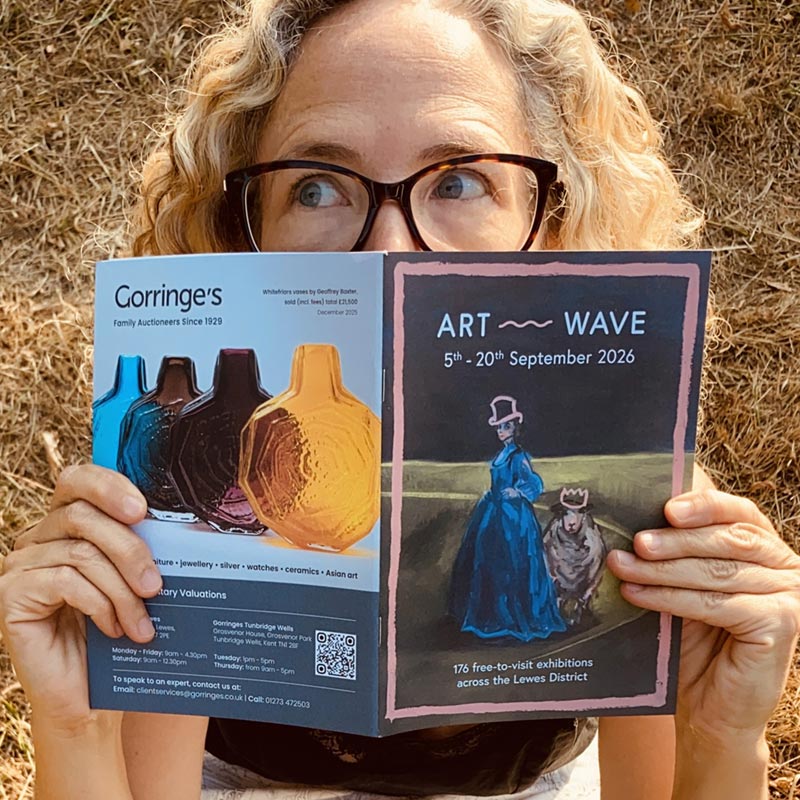
As I leafed through the Artwave brochure in what used to be my garden, now a mini savannah, I started wondering about the link, besides the pleasing wordplay. What does something like this cost, in the currency I usually think in? Not money. Carbon.
I went looking.
Art isn’t the problem
The global visual arts sector produces an estimated 70 million tonnes of CO2 equivalent a year, roughly what a mid-sized European country emits annually, according to Julie’s Bicycle, the charity that tracks this.
Worth some scale here before anyone panics: that’s a fraction of fashion’s roughly 1.2 billion tonnes, and well below commercial aviation’s approx 900 million. Art isn’t the villain of this story by any measure. But one number caught my eye.
Seventy-four percent of that carbon comes from one place: visitor travel. For an organisation the size of Tate, it’s closer to 92%. Not the paint. Not the canvas. Not the potter’s absurdly expensive kiln. Getting people there.
The more interesting question
Which isn’t “Is Artwave sustainable?” It’s “What do we get for the carbon?”
So I went looking again, this time for the receipt. It runs from a dying glacier in Paris, to your kid’s GCSE options, to a compliance software company in Lewes you have almost certainly never heard of. Here’s what’s on it.
One. It makes you feel it.
Olafur Eliasson tested this in 2014 with an art installation, Ice Watch: blocks of actual Greenland glacier, hauled to a Paris square and left to melt in public. People put their ears to the ice and listened to it crack as it died, which is not a sentence you can write about a spreadsheet. Someone, very sensibly, audited the carbon anyway: 30 tonnes of CO2 equivalent, 93% of it from trucking the ice from Greenland. Absurd, for a piece about the climate crisis. Also, rather the point.
Data reaches the head. Art reaches somewhere else.
Two. It gives the grief somewhere to go.
The World Health Organisation in Europe has reviewed the research and found that participatory, community-based art helps people process eco-anxiety and climate grief. It’s the opposite of doom-scrolling.
And it builds something that a leaflet about climate change can’t: collective agency – the sense that you’re not just watching the crisis happen to you, you’re standing in a room full of people doing something about it.
Three. It’s localisation, whether it meant to be or not.
Nobody is shipping work in from Basel for Artwave (I hope). There’s no fleet of vans crossing the Channel so Lewes can pretend to be an international art fair (I hope). A thousand-plus artists show work in the homes and studios where they already live, and most of us get there on foot or by bike.
That’s localisation, one of the core actions in the Ellen MacArthur Foundation’s own framework for a circular economy.
Artwave wasn’t designed as a climate intervention, but it behaves like one anyway.
Four. It grows the brains we’re actually going to need.
Climate change will not be solved entirely by people who are very good at Excel. We need engineers and scientists and people who can retrofit a house, obviously. We also need people who can imagine a future nobody’s seen yet, and make the rest of us want to live in it. That’s more or less what art teaches, which makes this a strange time to be cutting it from education.
Since 2010, GCSE arts entries in England have dropped 48%, dance by 60%, design and technology by 74%, largely because the EBacc doesn’t count arts subjects toward school performance.
Meanwhile the creative industries added £124.6 billion to the economy in 2022 and employ 2.4 million people, growing faster than almost anything else in it. We’re demonstrably good at this, yet we’re teaching it out of the next generation.
Five. It pays more bills than you’d think.
That economic data runs straight through Lewes too, some of it in plain sight. Gorringe’s logo is right there on the brochure, headline sponsor, saleroom on the High Street since 1929.
By my own rough (and probably conservative) count, Lewes has somewhere around twenty commercial galleries, studios and maker-shops running year-round. Not just the big names on the high street, but places like Oriana Evans Gallery 27, tucked away on Station Street. The Makers Directory lists over 600 artists and makers across the wider district. I tried narrowing that down to Lewes alone and lost count somewhere past a hundred. What strikes me is that Oriana Evans is a sole trader navigating neurodiversity, and it feels genuinely extraordinary that she took her gallery from an idea to an open door in a matter of weeks, smoothly, swiftly, with none of the friction you might expect. She credits it to Lewes: “I couldn’t have done this without my friends and community here.” Without doubt, Oriana is a force. But the town’s scaffolding is at work as much as her own drive; foot traffic, a maker culture, neighbours who show up when it counts.
And behind the High St, there’s so much more going on in the engine room. ArtAML™️, co-founded here by local heroes and art-world veteran Susan J. Mumford and technologist Dr. Chris King, builds compliance software for art transactions. Then there’s The Fine Art Company supplying restaurants and hotels, framers, printers, agencies like Studio Polpetto, and accountants who exist because there are enough working artists nearby to need them.
Which is resilience, obviously
Add it up and you get the word every climate strategy reaches for eventually: resilience. It’s in every council report, every funding bid, every consultant’s slide deck, usually without anyone quite defining it.
The economist Mariana Mazzucato has a better definition than most of them: culture, she argues, is vital public infrastructure, the thing that generates the creativity and shared values that let people flourish. Turns out that’s exactly what resilience means round here. A town where people make things. Where children grow up watching adults earn a living from their imagination. Where strangers talk to each other about a painting as well as the weather. You can’t offset that. You can only keep funding it.
Two waves
Which brings us back to the ice. Artwave’s own carbon footprint, like Eliasson’s melting glacier, is small change against what it actually buys a town like this one.
Heatwaves are coming whether Lewes wants them or not. Artwave is the one we choose, fund, and open our front doors for.
Because the climate crisis was never only about carbon. It is about people. About communities. About what makes a life, and a place, worth protecting in the first place.