
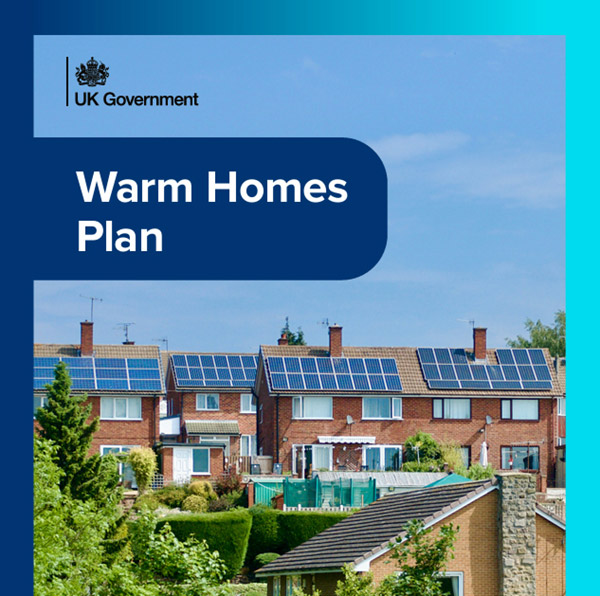
What the Government’s Warm Homes Plan means for your home
Nicki Myers of community energy company OVESCO looks at how the recently-announced Warm Homes Plan is set to support homeowners, residents and landlords looking to upgrade their home energy.
The Warm Homes Plan is the UK Government’s major new policy to help families cut energy bills, make homes warmer and more energy efficient, and accelerate the transition to cleaner heating and low‑carbon energy technologies. According to the Government, it represents one of the most significant investments in home energy upgrades in British history
At its core, the plan aims to:
- Cut household energy bills permanently by reducing how much energy homes use
- Tackle fuel poverty by lifting people out of high energy costs
- Support clean energy and jobs, growing the market for heat pumps, solar panels, insulation and related technologies.
As Ed Miliband, the Government’s lead minister on energy, has put it, the plan is about bringing “the benefits of clean power to people in their homes as quickly as we can”.
The Big Picture: what the plan includes
£15 billion of public investment
Over the next five years, the Government will deploy up to £15 billion in public funding to help households upgrade their homes with energy‑saving and clean energy technologies. This is designed to cover a broad range of measures including the workforce and heat networks needed as well as home energy improvement.
Up to 5 million homes upgraded by 2030
One of the plan’s headline goals is to support upgrades in up to 5 million homes by the end of the decade. These upgrades could include insulation, heat pumps, solar panels, batteries and smart controls.
Lifting 1 million households out of fuel poverty
The Government also expects this investment to help around 1 million households avoid or escape fuel poverty by reducing their energy costs.
How it works: grants, loans, and support
- Support for low‑income and vulnerable households
A significant portion of the funding — around £5 billion — is targeted at low‑income households and those in fuel poverty. This support delivers fully funded (grant) upgrades for eligible homes. Depending on the scheme and your situation, upgrades can cover insulation, heat pumps, solar panels, batteries and other measures at no upfront cost.
In England, local authorities are already delivering the Warm Homes Local Grant and similar schemes that offer free retrofit measures to people with lower incomes or benefits, typically for properties with a low EPC rating of D, E, F or G.
- Loans for all homeowners and landlords
All homeowners — and many landlords — will be able to access government‑backed loans at low or 0% interest to install technologies like heat pumps, solar panels, batteries and insulation. Details on how these loans will operate, including interest rates and application processes, are still being finalised and expected later in 2026. - Continued Boiler Upgrade Scheme (BUS)
The existing Boiler Upgrade Scheme — which currently provides up to £7,500 towards the cost of replacing a gas boiler with an air‑source heat pump — will continue as part of the wider plan through to at least 2029/30.
For landlords, renters and social housing
The Warm Homes Plan also includes measures to raise energy efficiency standards in the private rented sector. This means landlords will be expected to make upgrades to reduce bills for tenants; further detail on timelines and enforcement is still to come.
Support is also focused on social housing, with dedicated grant funding helping housing associations and councils retrofit their stock.
New delivery structures and jobs
To make all this easier to navigate, the government is also establishing a new Warm Homes Agency — a central service designed to help households and landlords find the right programmes and support for their needs.
Alongside this, the plan includes initiatives to help grow the workforce needed to deliver these upgrades. The government expects the shift toward clean heating and energy efficiency to support hundreds of thousands of new jobs by 2030 across installation, manufacturing and related sectors.
Beyond home upgrades: broader bill relief
In addition to direct home improvements, the government has already taken steps to reduce standing charges and overall energy costs, with estimates suggesting households will see around £150 per year cut from their bills, starting in April 2026, as part of wider energy price reforms.
What’s still to come
While the Warm Homes Plan sets out clear high‑level commitments, many of the detailed delivery rules — especially around loans, eligibility criteria and rollout timelines — are still being developed and are expected later this year.
Bottom line
The Warm Homes Plan is a major Government effort to modernise UK homes, reduce energy costs, tackle fuel poverty and support net zero goals — backed by the largest investment in domestic energy upgrades to date. It blends free support for those on the lowest incomes with broader access to clean energy finance for all households, while aiming to grow a skilled workforce to deliver this transition nationally.