

The Mica-Scope: A Town of Fixers
France pays you to fix things. Not in a fiddly-voucher, fill-in-three-forms way. You take your broken washing machine to an accredited repairer and €50 comes off the bill at the counter. Your shoes: €25. Your coat: €25. What would that mean for a town like Lewes that already punches well above its weight on repair? I’ve been thinking about it.
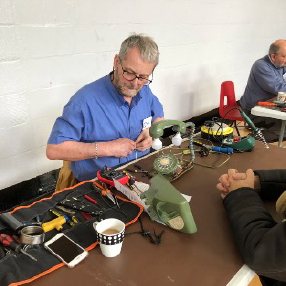
Every first Saturday of the month, a queue forms outside Landport Community Hub. People have brought things they cannot bear to throw away. A toaster, ten years old and worth ten more. A lamp with a fraying cable. A coat where the zip has staged a coup.
The Lewes Repair Cafe handles all of it. Volunteer repairers. Small grants. First Saturday, two until five. Free. It is one of the most useful things this town does, and it runs on the fumes of goodwill and grant applications.
Why we bin things
The reason repair needs its own monthly pop-up is straightforward. In the UK, it often costs more to fix something than to buy a new one. WRAP, the global climate action NGO that tracks what we consume and discard, publishes the data. Londoners alone spent £3.24 billion in 2024 replacing items they believed could have been fixed. That is not carelessness. That is rational behaviour in a system designed to make disposal cheaper than care.
And when we bin things, they do not disappear. The UK exported 598 million kilos of plastic waste in 2024, the third-highest volume in the world. The Environmental Investigation Agency, which published the original figure, framed it as 60,000 refuse trucks. A queue of 60,000 refuse trucks parked bumper to bumper would stretch from Lewes to Edinburgh. That is the volume of plastic we exported in a single year.
Most of it went to Turkey, Malaysia and Indonesia, where it lands near communities that did not produce it and cannot refuse it. Researchers and campaigners call this waste colonialism. When you sit with the figures, it is hard to argue with the framing.
The government built the conditions that made binning things the obvious move. It allowed mass production. It allowed mass marketing, most of it misleading. It enabled the infrastructure of disposal. The argument that it now owes us a correction is not idealistic. It is just the logical end of the chain.
What France did
In 2022, France pulled an obvious lever.
It launched the bonus réparation: a direct discount applied at the till when you take something to an accredited repairer. No forms. No receipts to post. Just a lower bill. Shoes, coats, washing machines, dishwashers, electronics, all eligible. Between €15 and €65 depending on what you’re fixing.
In the first year, 165,000 repairs were funded. France responded by doubling the bonus on five everyday items including washing machines, and widening the scheme to textiles and footwear. The money comes partly from manufacturers through extended producer responsibility rules. The companies that designed the throwaway economy are, in France, now contributing to the cost of unwinding it.
What Lewes could look like
Here is what a repair bonus would mean in this town specifically.
Abigail Petit at Abigail’s Drapery on the High Street is a maker and mender with a serious craft background. She charges £20 to £35 to darn a damaged garment. With a £20 subsidy at the till, that becomes a small decision rather than a significant one. Diana at DOLLY in North Court runs a zero-waste alterations and mending service, and teaches people how to sew and mend their own clothes. Kevin at Courtyard Shoe Repairs is an artisan shoemaker who has been restoring shoes and boots for years, currently Lewes’ only cobbler, I believe. Dr Bike has been running volunteer repair sessions since 1991. Lewes Cycleshack and Re-Cycles fix bikes at rates most shops in the county will not match. And the Lewes Climate Hub, the people publishing this newsletter, run Stitch & Mend Fridays with Lewes Repair Café sewists every third Friday of the month, free, on the High Street.
Lewes does not have a handful of amateur fixers. It has skilled craftspeople, many from serious making and design backgrounds, operating at the edge of what is economically viable because the system prices repair out of reach for most people, most of the time.
A subsidy changes the arithmetic. Kevin takes on an apprentice. Abigail hires. Diana expands. The Repair Cafe, freed from being the only affordable option in town, becomes part of a broader infrastructure rather than carrying the whole thing on its own.
There are empty shops on Lewes High Street. There are young people who could be trained in textile, electrical and mechanical repair. There is a town that already produces more skilled fixers per head than any reasonable probability would predict.
The government spent decades making disposal rational. Making repair rational is not a complicated ask. It is the same lever, pulled in the other direction.
France proved the model. Lewes has the people. The queue outside Landport Hub has been making the case every first Saturday for years.
Who else is fixing things in Lewes?
This column only has so much space. If you know a repairer, mender, restorer or general fixer in Lewes who deserves to be on this list, tell us. Drop a comment, reply to this newsletter, or find Mica at micajaniv.com. The more names on the map, the better.
Where to go in Lewes
- Lewes Repair Cafe — First Saturday of the month, 2–5pm, Landport Community Hub, Landport Road, BN7 2SU. Free.
- Lewes Climate Hub: Stitch & Mend Fridays — Every third Friday, 11am–1pm, 32 High Street, Lewes, BN7 2LU. Free, donations welcome.
- Abigail’s Drapery — Alterations and mending, 74/75 High Street, BN7 1XN.
- DOLLY Clothing — Alterations, mending and sewing classes, 3 North Court, BN7 2AR.
- Courtyard Shoe Repairs — Shoe repairs, leather work and key cutting, North Court (twitten off Cliffe High Street).
- Dr Bike Lewes — Volunteer bike repair sessions.
- Lewes Cycleshack — Bike servicing and repairs.
- Re-Cycles Lewes — Affordable bike repair.
Sources
- France’s bonus réparation — Service Public
- 2024 Repair Bonus: what’s new — Circular Place
- How France’s anti-waste laws are boosting repair shops — Textile Exchange
- Londoners spent £3.24bn replacing repairable items — ReLondon
- UK must end waste colonialism — Environmental Investigation Agency
- WRAP — The Waste and Resources Action Programme
Mica Janiv is a sustainability consultant based in Lewes. Read about her new column here. She works with businesses navigating the transition to a green economy. micajaniv.com