
Planetary Boundaries: what Bruce Phillips told Lewes Climate Hub — and why it matters
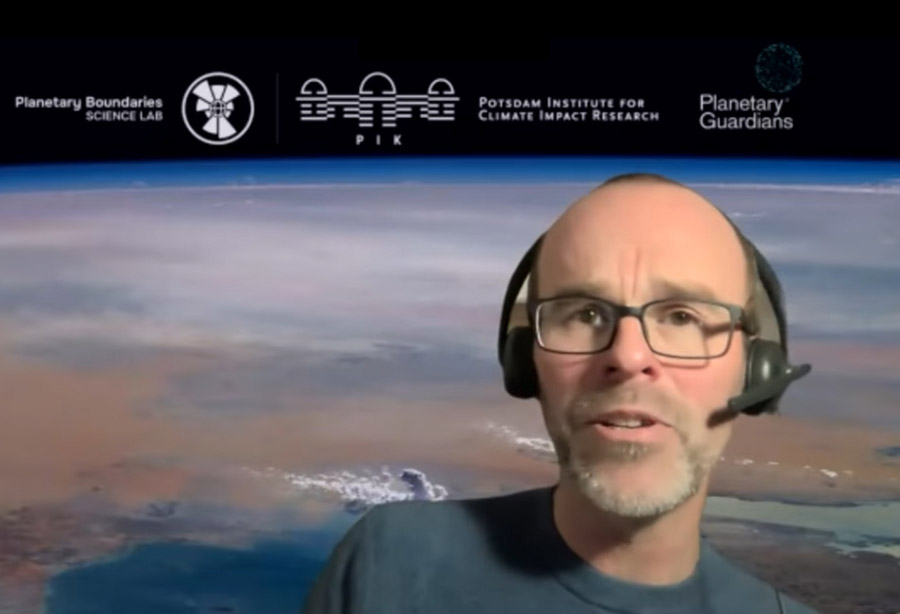
In a Zoom talk for Lewes Climate Hub on 12 February 2026, science communicator Bruce Phillips (Planetary Boundaries Science Lab, Potsdam Institute) set out a clear message: climate change is only one part of a much bigger story. The stability of our world depends on multiple Earth systems working together — and currently human activity is pushing many of them beyond safe limits.
Here are the key facts and takeaways from the talk and Q&A, which can be viewed on our YouTube channel here.
What the Earth gives us ‘for free’
The Earth provides three essential services that form the foundations of civilisation:
- Stability: For most of human civilisation, our climate and seasons have been relatively predictable, enabling farming, settlements, and complex societies.
- Resilience: Earth’s systems can absorb shocks (up to a point), buffering the impact of human pressures.
- Habitability (life support): Clean air, drinkable water, fertile soils, functioning ecosystems — all the basics that are very difficult (or impossible) to replace.
But these are not guaranteed: they rely on Earth’s systems remaining within certain climatic conditions.
The ‘tube’ of climate stability — and how fast we’re leaving it
Earth’s recent climate history features a narrow ‘tube’ of temperature stability within which humans have lived for hundreds of millennia. But the changes happening today are well outside established patterns:
- Emerging from the last Ice Age, even the fastest natural warming was only around 1°C over 1,000 years.
- Today we have seen c.1°C of warming in the last 40 years.
This increasing speed is of concern because life (including human systems such as agriculture) struggles to adapt to rapid change.
- The last time global temperatures were similar to today was around 120,000 years ago
- Sea levels were significantly higher than now – sea-level rise takes time to catch up.
Looking ahead:
- With current policies, the world is broadly heading towards 2.7-3°C of warming by 2100 (exact outcomes depend on what governments and societies do next).
- That would be likely to push us outside the ‘tube’ of long-term climate conditions which helped modern civilisation to develop.
The Great Acceleration
Since the 1800s, there has been rapid growth in population, industry, energy use, resource extraction and consumption. In effect:
- Socioeconomic trends accelerated…
- …and Earth system impacts accelerated alongside them.
The big question is whether the ‘improvements’ in human development can be maintained if we undermine the Earth systems on which they depend.
What are the planetary boundaries?
The planetary boundaries form a scientific framework for measuring whether humanity is staying within a ‘safe operating space’ — the zone where Earth systems are most likely to remain stable and resilient. The statistics are stark:
- 7 out of the 9 planetary boundaries are now outside the safe operating zone.
- Several of these are beyond the high-risk threshold.
Crossing a boundary doesn’t generally mean instant catastrophe, but carries a higher risk of destabilising Earth systems, including potential tipping points.
The nine planetary boundaries — in plain English
- Freshwater change
Not just how much water we use, but how water is distributed and recycled. Too much in one place (floods) and too little elsewhere (drought) both signal system stress.
This carries a crucial climate link: warmer air holds more moisture (around 7% more water vapour per 1°C warming), increasing the potential for heavier rainfall — yet hotter temperatures also increase evaporation, so extreme wet winters can still be followed by summer drought. - Biosphere integrity
More than ‘biodiversity’ (number of species), this concerns whether ecosystems still function properly, including the relationships between species. When those relationships break, nature’s ability to provide services such as carbon storage, water recycling and soil health weakens. - Climate change
This is driven largely by fossil fuel emissions; but ‘fixing the climate’ cannot be achieved without addressing other boundaries too. - Land system change (especially forests)
Forest loss reduces carbon storage, disrupts water cycles and damages ecosystem function. Global datasets (including satellite observations) are now being used to monitor changes. - Biogeochemical flows (nitrogen and phosphorus pollution)
The impact of fertiliser flow into waterways is one of the most severely-breached boundaries. Monitoring of the river Adur by the Potsdam Institute recently showed a sudden spike in bacterial counts — from normally below 2,000 to around 300,000 on 21 January — suggesting a major pollution event (possibly farm runoff or overflow).
There is typically a chain reaction:
• fertiliser runs off into rivers
• algae blooms
• algae dies and is broken down by bacteria
• bacteria use oxygen
• oxygen drops → fish die
This is eutrophication, which can also create ocean ‘dead zones’. - Ozone layer depletion
This boundary is one of the success stories: it has stabilised and is slowly recovering thanks to bans on CFCs.
But there are emerging pressures: some farming practices (including nitrogen oxide emissions) and even a surprising potential factor: satellite re-entry. When satellites burn up, they can release aluminium oxide, which may contribute to ozone impacts. - Ocean acidification
This boundary has recently moved beyond the safe zone. Oceans have been absorbing 25–30% of human CO₂ emissions and about 90% of excess heat from global warming, acting as a massive buffer. But the cost is rising:
• CO₂ dissolves into seawater → forms carbonic acid → oceans become less alkaline
• this affects shell-bearing sealife and food networks
• it can disrupt ocean ecosystems and oxygen production (marine algae hugely affect oxygen cycles) - Novel entities (new chemicals and pollutants, including plastics)
This is a growing problem because many chemicals entering the environment are not adequately tested or monitored, and regulation often lags behind innovation and industry pressure. - Atmospheric aerosol loading
Aerosols (particles) can cool or warm the atmosphere depending on type:
• soot/smoke tend to warm the atmosphere
• sulphur aerosols can reflect sunlight and lead to local cooling
A difficult trade-off: reducing deadly air pollution is essential, but doing so can unmask warming which aerosols have been hiding.
How the boundaries interact: oceans and biosphere as examples
These boundaries are not separate ‘silos’.
Oceans connect to multiple boundaries
- Oceans absorb CO₂ and heat (links to climate change)
- Acidification disrupts marine life (biosphere integrity)
- Nutrient pollution from land (biogeochemical flows) worsens ocean health and productivity
Biosphere integrity is about function – nature’s ability to keep doing its job – and not just species-count. An example is the issue of wildfires:
- Global burned area may be decreasing in some regions (e.g. African grasslands) due to land fragmentation and development…
- …But forest fires are becoming more severe in many places, with longer seasons and higher emissions — weakening forests’ carbon storage function.
Another item of concern is the Amazon tipping-point risk:
- Heavy deforestation and warming could push the rainforest towards a point where it flips into a grassland-like state.
- Even stopping deforestation later might not prevent the shift if the system has lost too much resilience.
Even a 1 in 100 chance of collapse is not a gamble that we would find acceptable in ordinary life-choices.
Agriculture: the big driver across almost everything
- The food system is deeply tied to land change, fertiliser pollution, freshwater stress and biosphere decline.
- The Potsdam Institute supports work on the Planetary Health Diet — designed to keep humanity within safe boundaries while feeding everyone well.
Cattle have the greatest single impact
Recent work suggests that cattle have the largest overall footprint, though with caveats:
- In a small number of contexts, grazing can be compatible with ecosystem goals
- In many places, cattle are not purely grass-fed, especially in winter (feed has to be grown somewhere)
A rule-of-thumb beef consumption target from the Planetary Health Diet advises the equivalent of a medium-sized hamburger per week.
- Recent research claims that climate change could reduce suitable grazing lands for cattle/goats/sheep by up to 50% by the end of the century — meaning that change may become unavoidable.
Military impacts: likely to be significant, but not fully assessed
- The impact of war and the defence sector on the planetary boundaries has not yet been fully assessed
- It is likely to be significant, especially for land change, novel entities, and biosphere disruption
- Some militaries have shown interest in climate risks (particularly around geopolitical stability), though whether that translates into change may vary.
Monitoring and the politics of data
Monitoring Earth systems relies on satellites, buoys, and long-term measurement programs — and there is concern about losing monitoring capacity due to political decisions and funding cuts (especially in relation to some US programs).
Of key importance is monitoring for tipping points, including:
- Ice sheets
- Boreal forest dieback
- Coral reef collapse
- Amazon rainforest dieback
- AMOC (Atlantic circulation)
On AMOC:
- It helps to keep Western Europe warmer than it otherwise would be
- A major slowdown is more likely after 2100 than before, but there is a possible 10% chance of this occurring earlier
- Potential impacts would include more extreme winters in Western Europe even as global average warming continues.
Time scales: what does ‘survivable’ mean?
While such a scenario does not imply imminent human extinction, the consequences of current climate change trends are likely to be severe.
- World average temperature increase is likely to exceed 1.5°C in the near term (perhaps becoming permanent within the next few years), and then become formally ‘passed’ within 5–10 years — depending how defined.
- After a 2°C increase, impacts become significantly worse, with escalating exposure to dangerous heat and higher risks of major system shifts.
- Adaptation isn’t painless — ‘adapting’ might mean losing homes, livelihoods, and stability.
- Even achieving 0.1°C less warming matters — especially beyond the 1.5°C increase.
- Risk increases gradually (not a cliff edge), but the curve steepens.
Coral reefs are a clear instance of an environment threatened with significant deterioration by the end of this century.
What individuals can do — and why it’s not ‘pointless’
There is a danger of paralysis through individual indecision and feelings of powerlessness. Suggested ‘quick wins’ to reduce emissions by 10-20% (depending on circumstances) are:
- Reduce food waste
- Explore the Planetary Health Diet (flexible, not ‘all or nothing’)
- Use data tools such as Our World in Data to compare impacts by food type
- Move money: banking and pensions can fund fossil fuels; switching can reduce indirect emissions
- Vote: policy drives system-level change
System change still starts with people:
- Social change spreads through networks (“Convince three people… then they convince three…”)
- Public pressure and campaigns can shift corporate behaviour
- 5% of a population pushing consistently can force major change
Change at a higher level is more likely to come down to economics and subsidy structures than to any impact from oil majors investing in renewables.
AI: energy, water, and misinformation
- Data centres use large amounts of electricity and water (for cooling)
- A recent report suggests that the US is currently the worst offender in powering AI growth with fossil fuels, while many Chinese data centres are more renewables-powered
- There is, separately, an AI misinformation risk in the fight to deal with climate change: well-funded actors can use AI to generate huge volumes of misleading content, which can overwhelm public decision-making
- Stronger regulation is required; and AI systems can make errors — especially risky for scientific work if used uncritically
The Potsdam Institute itself uses advanced computing/AI for research — but powered by renewables and with waste heat used efficiently (e.g. for campus heating).
How to talk to friends and family (without triggering backlash)
- Lead with benefits, not guilt (money saved, health improved, convenience, pride)
- Always pair the problem with a solution
- Make it relevant to what they care about (sports disrupted by extreme weather, coffee prices rising, local flood risk, etc.)
- Keep it simple and short
- Use local examples and visible evidence
- Avoid guilt-tripping (it often causes defensive backlash)
- Try ‘challenge’ framing for competitive personalities (e.g., a one-week experiment)
Resources to explore further
- Planetary Health Check (annual report and updates): planetaryhealthcheck.org
- Planetary Boundaries Science (their YouTube channel)
- Project Drawdown and its Solutions Explorer for sector-by-sector solutions (buildings, transport, industry, etc.)
- Global Forest Watch as an example of how satellite monitoring can detect deforestation at very detailed scales