
Planetary Boundaries season: What did we learn?
Scott Donaldson brought the idea of holding a Planetary Boundaries season to Lewes Climate Hub. He reflects on what it told us about the health of our planet and the actions the world needs to take now.
Plus, view the presentations, films and displays from the season on the Hub’s dedicated online Planetary Boundaries page.
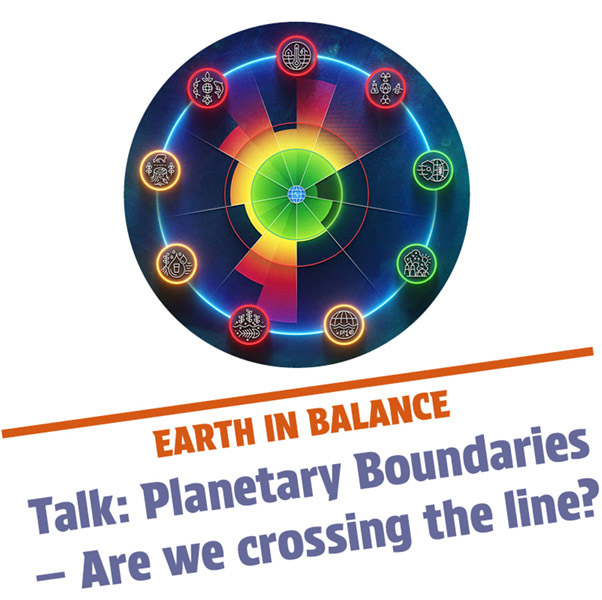
The Planetary Boundaries (PB) framework has become a widely accepted and quoted method of assessing the health of our home planet and all the precious life it supports – including humans and their ‘civilisations’ of course.
Its development began in the 2000s, with a large interdisciplinary team of scientists from the Stockholm Resilience Centre at Stockholm University, working with other key institutions like the Goddard Institute for Space Studies at Columbia University in New York, and the Potsdam Institute for Climate Impact Research (PIK, where the Planetary Boundaries Science team are now based).
The framework attempts to assess the health of the whole Earth system, first by identifying its key subsystems; then by deciding how to measure the functioning of each subsystem at a global level, via a relatively simple number or two; and finally by agreeing what numbers would put the subsystem outside the ‘safe operating space’ and threaten risk and danger to us and life in general.
The process took many years and is still being refined, but by 2023 nine critical subsystems had been identified, how they should be measured had been agreed, and safe limits to those measurements had been settled. From 2024, the PB team at Potsdam has committed to publishing an annual ‘Planetary Health Check’ report. Its 2024 report found that 6 of the 9 boundaries had been crossed and were at risk or in danger; the 2025 report increased the number outside the ‘safe operating space’ to 7.
You can see what the nine PBs are and how they are assessed in the talk given at the Climate Hub by PIK’s Bruce Phillips (who is coincidentally from East Sussex), plus detailed graphic explanations of each of them, and more, here.
The impact of our food system
When I started reading about the PBs, one thing which stood out very clearly was the role of agriculture and the global food system in pushing us into danger. A 2017 science paper put agriculture in the dock as overwhelmingly the biggest contributor by far to four of the PBs: biosphere degradation, land system change, nitrate/phosphate pollution, and depletion of fresh water; all of these are far outside the safe operating space.
Agriculture, and the food system as a whole, also play major roles in climate change, ozone depletion (through agriculture’s nitrous oxide emissions), novel entities (biocides, GMOs, plastics), ocean acidification and aerosols. To me, this suggests that the number one priority for action is the extractive food system, especially when you consider its responsibility for the plague of non-communicable diseases (cardiovascular, diabetes, obesity, cancer, etc).
A second observation on the boundaries – or a question, rather – is: What is the combined contribution to the PBs of the defence industries and the actual ongoing conflicts which consume their products? This question looms ever larger as forever wars escalate – Iran, Gaza, Ukraine, Sudan… No study seems yet to have been attempted, though some estimates of global military fossil fuel emissions alone have been made, and the US military’s emissions are thought to make up around 20% of the whole of the USA’s. However, no systematic assessment has been made of all nine boundaries – and even for fossil fuel emissions, reporting from the military is anyway optional for countries, so we really don’t know.
I hope one valuable thing the popularisation of the PB framework can do is to help more people understand and appreciate better our awesome Earth system – if only in a backwards sort of way – by highlighting the critical subsystems that together create this wonderful planet – as well, of course, as alerting us to what’s going wrong and what needs to change.